As of this writing, I list The West Wing as my second-favorite TV show of all-time, behind only Star Trek: The Next Generation and ahead of Game of Thrones (which […]
Rate this:
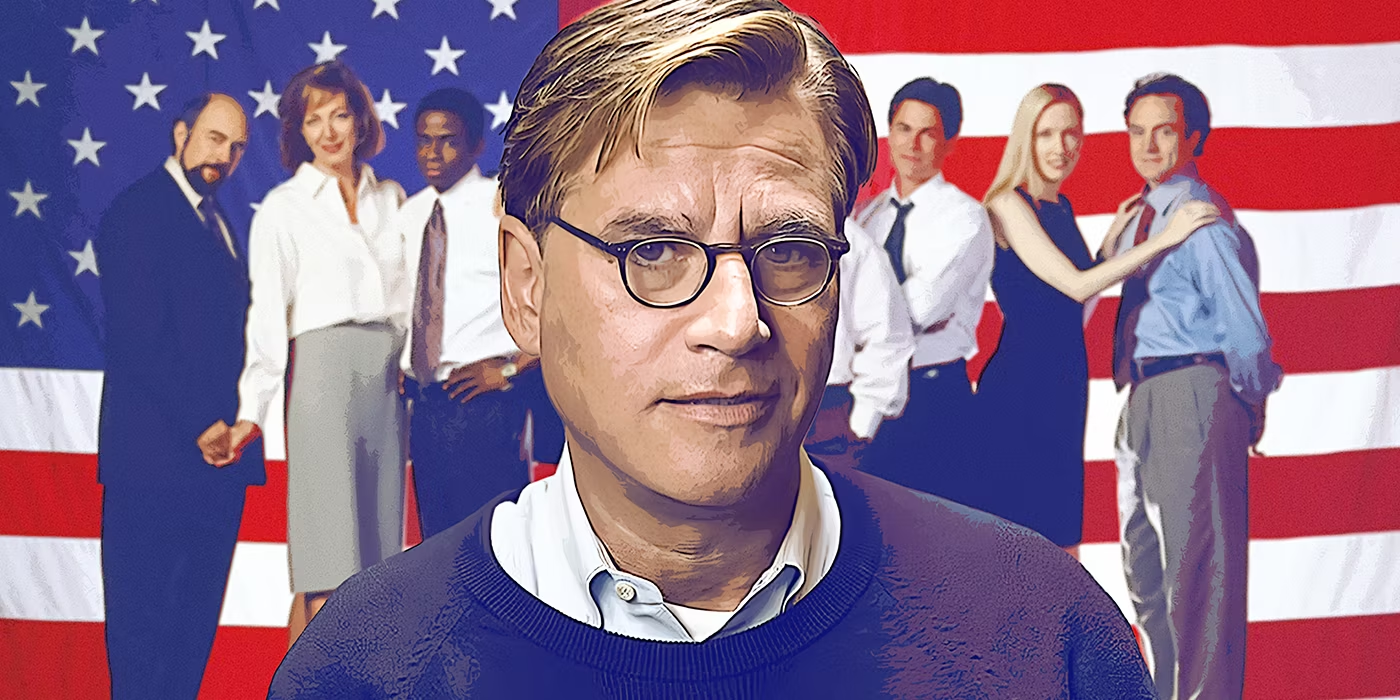
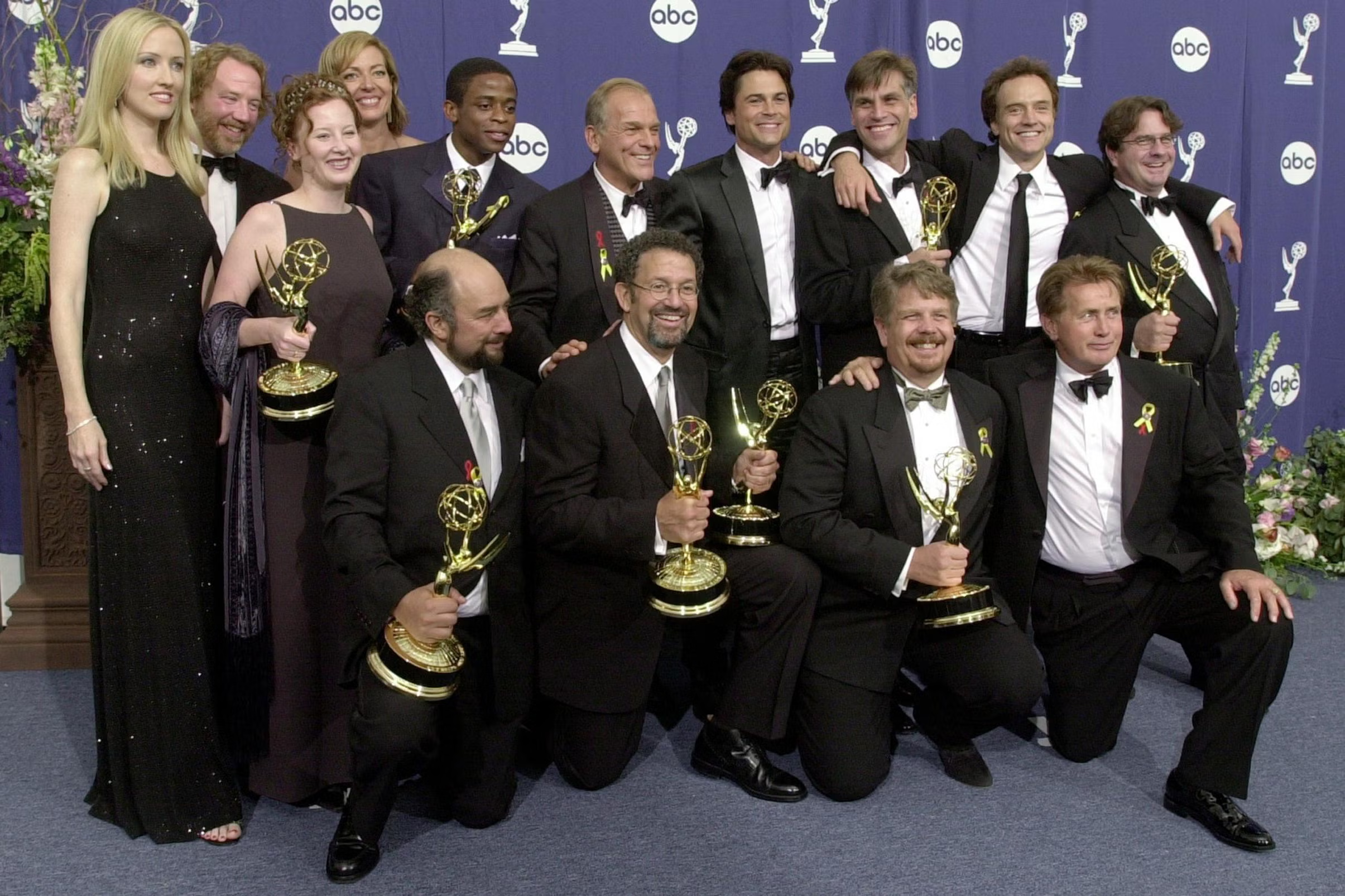
As of this writing, I list The West Wing as my second-favorite TV show of all-time, behind only Star Trek: The Next Generation and ahead of Game of Thrones (which could’ve and should’ve ended up at #2 if not for the problems with the last two seasons). Created by my favorite screenwriter, Aaron Sorkin, I first started watching it live probably at some point in season 5 or 6, fell in love with it, and later caught the beginning of the show on DVD, which only solidified its place among the all-time greats. It won Best Drama Series at the Emmys in its first four seasons, an incredible feat. And it was nominated for all seven seasons. What I loved most about it 20 years ago, and still today, was that it often showed us the way we hope government would function. It had an idealism that I latched onto at a point in my life where I was impressionable and had just started following politics post-9/11.
The show was made during a time of divisiveness in our real-life politics, but at a point when we were still years away from the partisan dumpster fire that Washington is now. I’m sure that The West Wing probably felt just a little too idealistic for its time. Watching it now, sadly it feels like pure fantasy, existing in some alternate universe where they don’t elect psychopaths and dimwits into high elected office. Thems were the days.
Of course as a writer, the show’s writing is what drew me in first. The fact that Aaron Sorkin was only 38 when the show began blows my mind and fills me with envy. The fact that they could make shows this good with 22 or 23 episodes in a season is even more wild. We’re now accustomed to the best shows being 10-13 episodes per season, looking like movies, and almost always being cable or streaming shows. The West Wing was an old school network drama that started airing in the stone age of 1999, before HD was a thing. It transitioned into HD it in its later seasons, but a lot of those early episodes look rough by today’s standards. But it was never shot like a movie. It relied on its writing and the performances of its grand ensemble. I can’t help but imagine what 22 episodes in one season of House of the Dragon would cost now (and how amazing it would be to have seasons that long of shows like that). One can dream. That said, I do prefer today’s standard of shorter seasons. It would be impossible financially to do network-length seasons for most of today’s biggest shows.
I began the rewatch on May 22 and finished it the day I began writing this post, September 11, 2024 (of course I was watching other things in the meantime). So what did I glean from watching 155 episodes of 42-minute shows all these years later? The thing I was looking for the most was whether or not the show took a noticeable dip in quality after Aaron Sorkin left at the end of season 4, as many critics would have you believe it did. I’ve always contended it was still great after he left, but with many years of life experience later, would that opinion hold up? Would any episodes rise in standing now that I know even more about politics? Would the entire show somehow be diminished given the times we now live in? I’m pleased to report I have the answer to all of those questions.
I found that most of my favorite episodes remain my favorite episodes. I’ve been through the entire series probably 4 times now and didn’t really expect any shocking new discoveries. I’m sure I enjoyed some episodes more or less watching it today, but I don’t believe there were any drastic changes from what stood out to me 15-20 years ago to what I found the compelling now.
As I was doing the rewatch, I rated every single episode on IMDb as I went. For my fellow stat nerds, here’s the breakdown:
(I gave only three episodes a perfect 10 and no episode scored below a 7)
Season 1: 7’s (3), 8’s (17), 9’s (2) – 7.95 average Season 2: 7’s (6), 8’s (10), 9’s (4), 10’s (2) – 8.09 average (BEST SEASON BY THE NUMBERS) Season 3: 7’s (6), 8’s (14), 9’s (2) – 7.82 average Season 4: 7’s (7), 8’s (14), 9’s (1), 10’s (1) – 7.83 average The Sorkin Era totals: 7’s (22), 8’s (55), 9’s (9), 10’s (3) – 7.92 average Season 5: 7’s (9), 8’s (11), 9’s (2) – 7.68 average Season 6: 7’s (14), 8’s (8), 9’s (0) – 7.36 average (“WORST” SEASON BY THE NUMBERS) Season 7: 7’s (9), 8’s (11), 9’s (2, including “The Debate”, which was an 8 but I gave an extra point to because they really did perform it live, which was incredibly ballsy) – 7.68 average Post-Sorkin Era: 7’s (32), 8’s (30), 9’s (4), 10’s (0) – 7.58 average
This gives us an average rating for all 155 episodes of 7.77. That means I technically should’ve rated the show as a whole an 8, but I give it a 9 because of all it’s meant to me and all the ways it’s inspired me over the years. Rating movies and TV shows is certainly not a scientific process, but I suppose this indicates it could be!
The episodes receiving perfect 10 scores were S2E10 “Noel” (where Josh meets with a psychiatrist to help him with his PTSD after being shot during the assassination attempt), S2E22 “Two Cathedrals” (which includes the famous scene of Bartlet cursing out God in Latin inside the National Cathedral and is widely considered one of the best episodes of television ever made) and S4E23 “Twenty-Five” (where Bartlet learns of his daughter’s kidnapping and eventually relinquishes his presidential duties). I’m still amazed that Sorkin left the show on a cliffhanger, leaving his successors to wrap up perhaps the most pivotal storyline in the entire series. I can’t decide whether that’s a mic drop or dereliction of duty as a storyteller. Zoey Bartlet‘s kidnapping, which takes up 4 consecutive episodes, could have been its own TV movie.
Also noteworthy: season 7 ended with seven 8’s in a row, which to me indicates the show as a whole ended really strong. Yes, the Sorkin Years were better on the whole. That’s no great shock, but they did pretty well without him using a much larger cast when you include the members of the Alan Alda and Jimmy Smits presidential campaigns. Fewer characters means tighter stories and more resolution, and we got more of that in the early years.
What about the most important question? Well, the verdict is in. I maintain the show is still great after season 4. In fact, those 4 episodes in the later seasons I rated a 9 are just as good as some of Sorkin’s best work in the early seasons. So what, if anything, was missing after Sorkin left? The biggest things he did better that I noticed a drop-off in the later seasons were the quality of the pre-credits scenes and some of the endings. Sorkin was a master at hooking you before the credits hit and a master of clean and poignant endings, while a lot of the episodes in seasons 5-7 end abruptly and the opening teases were usually much flatter. Those may seem like small details, but from a writing standpoint I assure you, they ain’t. The show was more focused in the earlier seasons as well, primarily because we were only following storylines within the White House, whereas in seasons 6 and 7 we’re following the White House and two competing presidential campaigns, of which there was no resolution until the end of the show.
That said, I don’t really feel like the writing fell off significantly under John Wells‘ leadership as showrunner. Most of the staff writers from the early seasons stuck around til the end, so the character development remained consistent. I think they did a fantastic job maintaining Sorkin’s fast-paced, hyper-smart dialogue, often in the form of the famous walk-and-talks where many viewers might need captions to keep up with whatever inside-baseball political topic the characters are talking about. Of course Sorkin was the best writer the show ever had because nobody alive can match his dialogue. But if I had to throw out a number, I’d say the falloff in the writing was maybe 15%. The people Sorkin brought along with him who continued working on the show all the way through are also excellent writers, and together, they made it work.
My favorite non-Sorkin episode remains “The Supremes” from season 5. It holds up beautifully, and is one of the best episodes of the entire series, Sorkin-written or not (this one happened to be written by the brilliant Debora Cahn). I’ve always been fascinated by the inner workings of the Supreme Court, and this episode focused on the political maneuverings to get not one, but two new Supreme Court justices on the bench in one fell swoop (featuring marvelous guest star roles for Glenn Close and William Fichtner). It was a highlight episode for Bradley Whitford‘s Josh Lyman character.
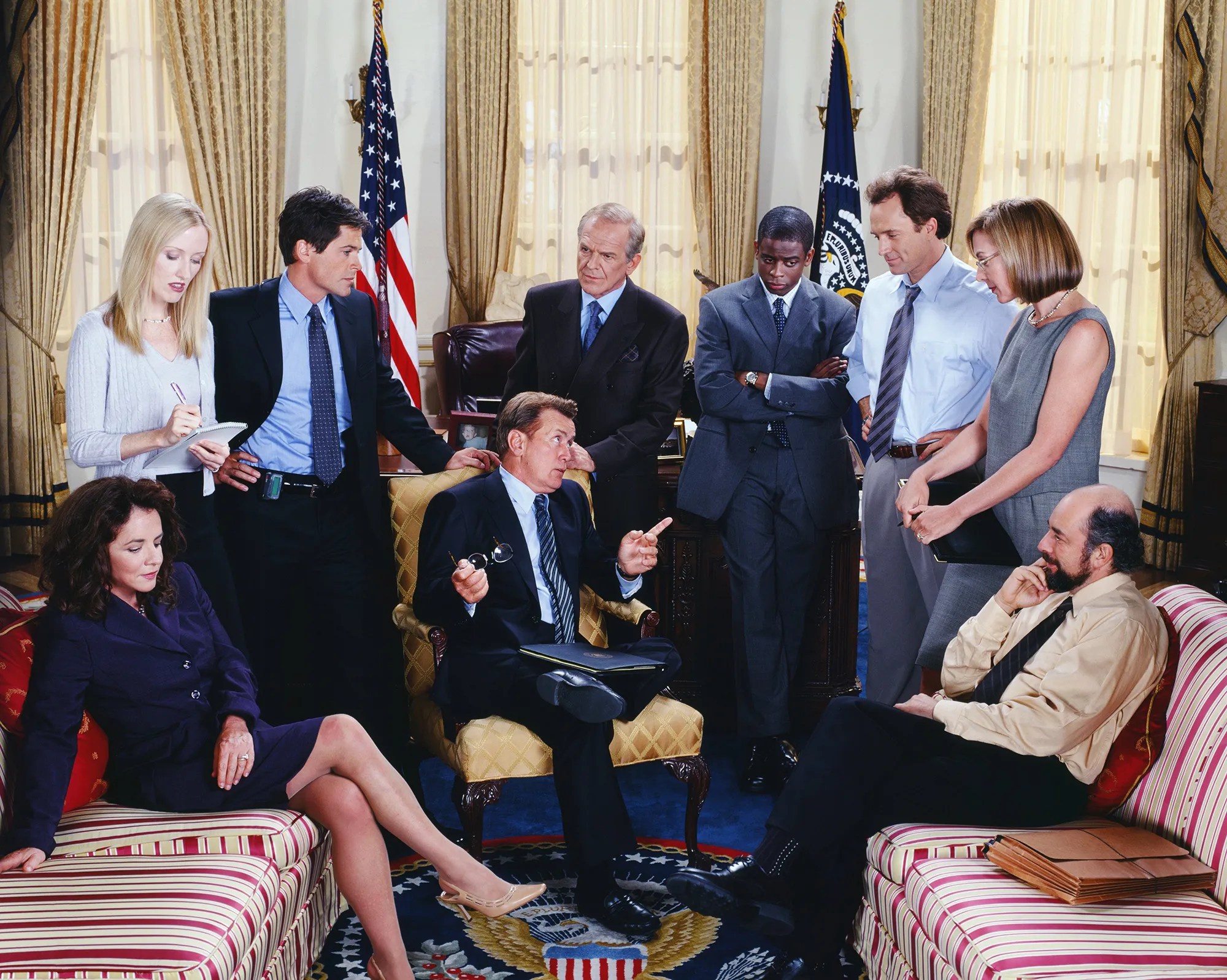
And what about those characters? Well, Richard Schiff as Toby Ziegler is still my favorite character in the show. I feel a sense of kinship with many of his character traits, from his being a writer, the refusal to let go of his core beliefs to his misanthropy towards most other people, which still elicits some hearty lol’s for me. And he smokes cigars. My guy! This rewatch reminded me how much I miss John Spencer, who died of a heart attack at just 58 during filming of season 7. This show was the highlight of his (and most others’) career, and it was made even sadder by the fact that he had to act out his character having a serious heart attack in season 6. Bradley Whitford shines as well, and of course Martin Sheen‘s Josiah Bartlet was the kind of president many of us dream to have in office, despite his flaws. Rob Lowe does his best work as the brilliant Sam Seaborn. Everyone is great, obviously. I’ll also tip my cap to a few of the supporting players, notably NiCole Robinson‘s secretary character Margaret, Oliver Platt as White House Chief Counsel Oliver Babish (who gets some of the best one-liners in every episode he’s in), and John Amos as Chairman of the Joint Chiefs Admiral Fitzwallace (Sorkin’s respect for the military is one of his trademarks). I could go on, but those are my favorites. In the later seasons, I think Alan Alda as Republican presidential nominee Arnold Vinick stands out above the rest. If only we had sane Republicans like this in 2024. The amount of people who did career-best work on this show is all the tribute it needs, really.
I noted above how the show isn’t known for its flashy cinematography, but that doesn’t mean there aren’t plenty of great shots and filmmaking tricks on display. The show had a crew of A-list TV directors (Thomas Schlamme, Christopher Misiano, Alex Graves and Alan Taylor to name a few), many of whom are still busy today (Graves & Taylor later directed several episodes of Game of Thrones). The show also had a lot of fantastic female directors a decade before the internet outcry for equality in Hollywood made hiring women directors a virtual requirement. Sorkin’s patented use of fantastic needle drops introduced me to some of my favorite songs. This show was the first time I ever heard Jeff Buckley‘s version of “Hallelujah” (which I still contend is the best cover song ever made) and Massive Attack‘s “Angel”, both of which have been mainstays on many playlists of mine over the years.
Does the show have any flaws? Not any huge ones. Are its politics too blatantly liberal? That’s in the eye of the beholder, but as an independent myself I never thought it went too far. Sorkin has this weird obsession with zany physical comedy (people tripping over things, dropping large stacks of papers, falling out of chairs, etc.) that I’m glad mostly went away after he left. And while I think Dulé Hill is usually excellent as Charlie Young, as the only black regular cast member, I still feel like Charlie is too often presented as this perfect angel of a human. It’s a little cringy at times, but certainly not a dealbreaker.
I think John Wells and his team carried the show forward living up to impossibly high standards and brought it home admirably. I think the story progresses as it should have and the show ends the way it had to, with Bartlet passing the torch to the next president. You could make the argument that they could’ve stayed inside the White House during the election process to determine his successor, but I don’t think that would have worked as well. I enjoyed watching the inner workings of two opposing presidential campaigns. Yes, it means some of our main characters from the first 5 seasons get less screen time, but for the show I think it made sense. We’d already seen an assassination attempt and the president’s daughter being kidnapped. How many other earth-shattering calamities do we impose on one administration before it becomes too unrealistic? I think the show had to end with finding out who the next president in this universe is and how Bartlet finishes his second term. And that’s what we get.
I believe this show made me a smarter person and a better writer. It taught me to have high standards. It taught me a lot about etiquette and how to be a professional in the workplace. It taught me about some of the subtleties of human interaction, as grandiose a thing to say as that might be. It showed me when it’s right to fight for what you believe in and when you have to shut up and stay in your lane. It was the first TV show that I fell in love with purely for its writing and overall quality. Having seen it for the first time in my twenties, it showed me what the world could look like, and I don’t fault it at all for its optimism. Put simply, it’s one of the most formulative and influential pieces of entertainment of my lifetime, and it came along exactly when I needed it. Moreover, it’s the best thing Aaron Sorkin, one of my heroes, has ever done.
After The West Wing ended in 2006, we wouldn’t get a show depicting Washington politics this riveting until House of Cards in 2013. Two very different shows, obviously, but both gave us must-watch alternatives to the American politics of the real world.
Up next on my TV rewatch list: Entourage, which, god help me, debuted 20 years ago now. Fuck I’m old.


 BIGGIE'S PLACE
Good Lord this is awesome!
LikeLike
Stumbled upon this and am very glad I dud. What a thoroughly cogent, insightful and interesting review.
LikeLike